



 27 / 50

International Working Committees
This question raised the interest of some CFOs who for
instance recommend as follows: «If no amortisation
reintroduction will be possible, then are absolutely
important: a) standardisation of mechanism on
WACC, g rate and other parameters; b) possibility to
reaccount an impaired goodwill in front to different
economics conditions; 3) impose very mandatorily
all the sensitivities to be done and to be reported
in the disclosures», or suggest that the relevance of
benchmarks and specialized firms, or the need of
standardised test methods considering also the capital
market valuation practice or another that firmly states
as follows: «I believe the current approach is the best
even though it introduces subjectivity».
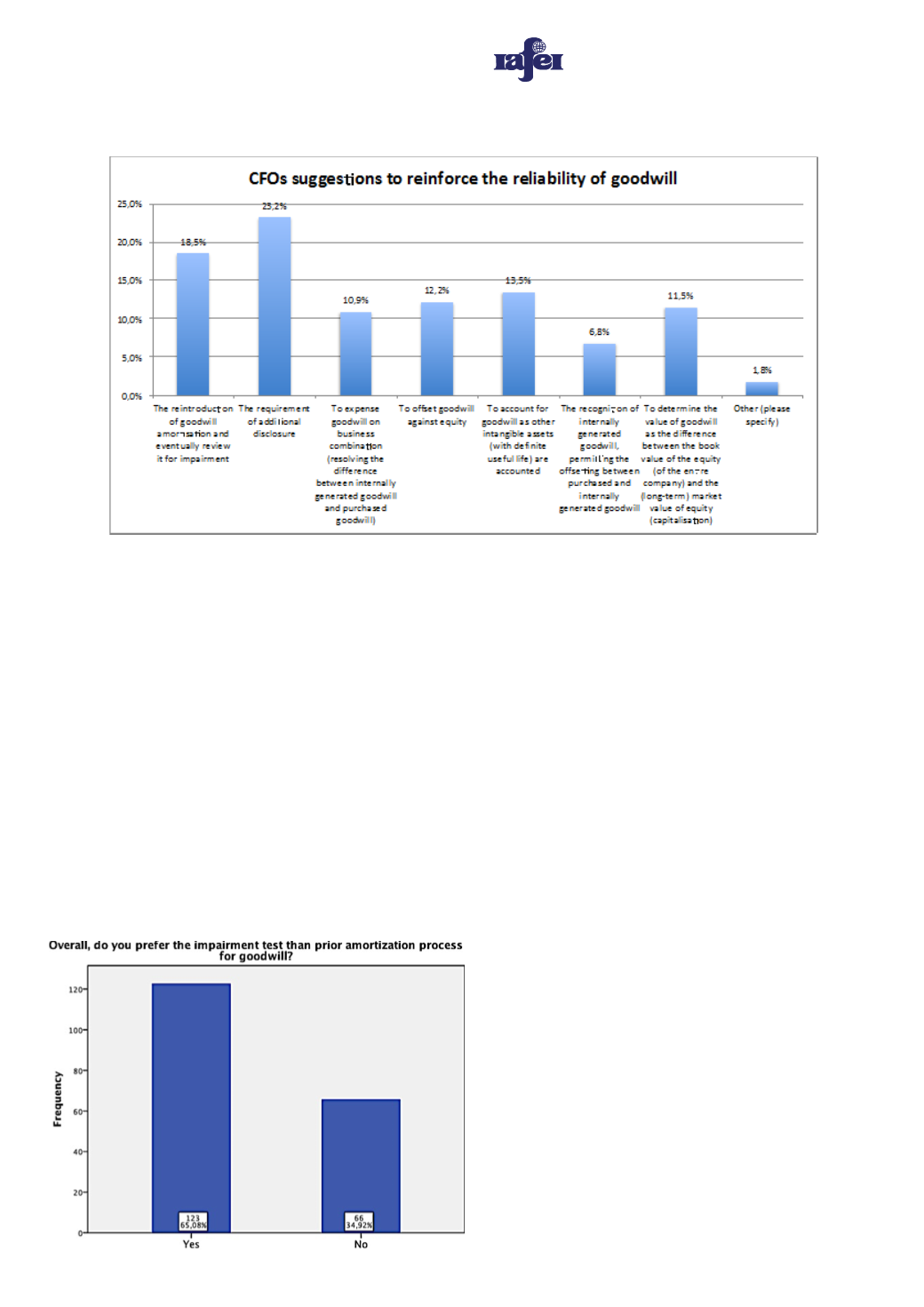
Purposely, the questionnaire concludes by asking CFOs
their overall preference between the impairment test
and the amortization process and more than 65% of the
respondent CFOs prefer the impairment test.
Discussion
The conclusive question on the CFOs preference
between the impairment test and the amortization of
goodwill directly answers to the EFRAG recent debate on
a possible reintroduction of the goodwill amortization.
Although the difficulties underlined to implement the
test, the 65% of the respondents prefer the impairment
of goodwill. However, the remaining 35% still prefer the
amortization process.
We conclude this report with some of the CFOs
suggestions and recommendations, which might
constitute the case for future investigation. Interestingly
a CFO suggests to «review/propose impairment test
methods/tools», hence future accounting studies
might create a tool to assess the effectiveness of the
impairment test.
On the other hand, another CFO points out how actually
in liquid and transparent markets the market operators
are sufficiently prepared to estimate fair value estimates
and that they can adjust their expected cash flows,
the fall in the share price as a consequence advances
the recognition of the impairment losses. This CFO
expresses as follows: «My sense is share price falls after
impairment write downs are more sentiment driven and
a reflection on the ability of the relevant management to
communicate future direction. After all, an impairment
is a correction of a past action (an acquisition) and if the
market assesses the acquisition won’t justify the price
paid (i.e. the company has overpaid), it will adjust the
share price immediately and not wait for a subsequent
impairment». However, we then could ask (as a future
research question): does the market anticipate or react
to goodwill write-offs?
27