



 26 / 50

International Working Committees
CFOs are concerned about both of them (about 49.3%
and 40.3% agree).
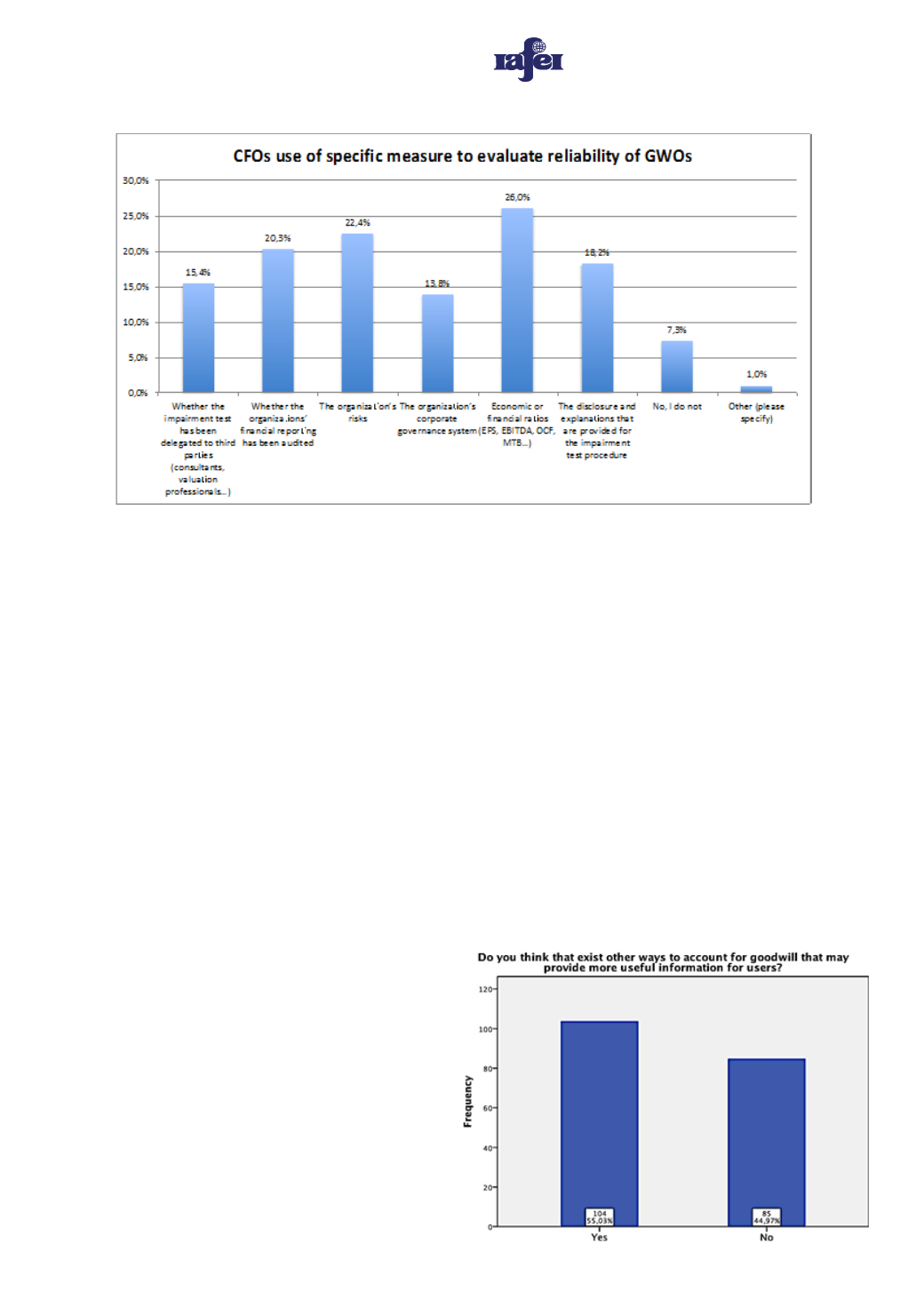
Do CFOs use specific measures/procedures to evaluate
the overall reliability of goodwill impairment test?
About 26% of CFOs use economic or financial ratios,
22% evaluate the organization risks and about the 20%
takes into account whether the financial report has
been audited. Significantly important is considered by
about 18% of the respondents also the disclosure and
explanations provided for the impairment, while the
15% take into account whether the impairment test
has been delegated to third parties and the 14% the
company corporate governance system. We did not
expect that the 7% do not use any specific measures
or procedures to check the reliability of the process.
A CFO than specified that he (or she) uses the historic
performance of the cash generating unit while another
revealed to use the sensitivity analysis disclosed.
Do CFOs compare their evaluation with other
evaluation(s) of subjects in other positions?
Again, we did not expect that so many respondents do
not compare their evaluation with the evaluation(s)
of other subjects (20.6%), this result may contribute
to the behavioural studies on the top-executives
overconfidence. Although, 15.6% of the participants
admit to compare their evaluation with those of the
controller, 9.9% with those of the internal auditor, 8.3%
with those of the process owner and with those of the
risk managers and 6.0% with those of the compliance
officer.
Which is, at the end, CFOs opinion on the current
accounting method for goodwill?
It is relevant that more than half of the respondent
CFOs (55%) is convinced that there are other accounting
treatments for goodwill, which might better fulfil the
information usefulness objective of financial reporting.
More than 23% of CFOs suggest the requirement of
additional disclosure. Awidepercentage (18.5%) believes
also that the reintroduction of goodwill amortization
and its eventual review for impairment might solve the
reliability issues. We can see that also accounting for
goodwill as other intangibles (with definite useful life)
is perceived as a good solution (13.5%) as well as to
offset goodwill against equity (12.2%) or to expense it
on business combination (10.9%) or to determine the
value of goodwill as the difference between the book
value of the equity and the long-term market value of
equity (11.5%). A part of the participants (6.8%) believes
also that it could be satisfactory to account for goodwill
as other intangible assets with definite useful life are
accounted.
26